Showing posts with label EP Road Trip. Show all posts

Monday, August 13, 2012

EP Road Trip: Mahone Bay and Lunenburg

EP Dave is back! And what a way to rejoin the world - with a road trip! My roommate was leaving back home for Korea, and I thought I would like to treat her to a special trip.

When I was in Korea in 2009, I was guided on a train tour of South Korea by a total stranger. Some random woman I met in the Secret Garden at Changdeok Palace in Seoul, South Korea, befriended me and then invited me on a tour of all her favourite spots around South Korea. It was truly an experience I would never forget, and one that would change my life forever.

I asked the woman how I could ever repay her, since I wasn't exactly loaded with money at the time. She said that I could repay her by returning the favour to any Korean visitors I met in Canada.

So, fast forward to January 2012, and my roommate of the past seven months is about to return home to Korea without visiting the one place every Korean knows, PEI (the home of "red-hair Anne"), and only ever having travelled by bus to tiny Truro. No offense to Truro, as I'm sure it's a lovely town, but the Acadien who lived there before the British stole it from them originally named the place "Village in the burnt wood."  That's probably not exactly the postcard image of Canada she would like to take home with her.

I knew what I had to do. While I couldn't afford the time or the trip to PEI, I did the next best thing - I took take her to Lunenburg.

According to Wikipedia, Lunenburg was one of the first attempts by the British to settle British Protestants in Nova Scotia, back in the 1750s. This makes it somewhat special for two reasons.  First, they actually settled a new area and didn't just steal a settlement from the French or Mi'kmaq, but also this influx of Protestants resulted in Lunenburg being attacked by the Catholics nine times!

More importantly, in modern times, Lunenburg is the best remaining example of a planned British colonial settlement in North America.  It was awarded UNESCO World Heritage Site status, accordingly, in 1995.


On the way over, we took the Lighthouse Route along the coast and stopped in at beautiful Mahone Bay.  Mahone Bay is famous for its cafe on the side of the road.  No wait... that's not right.


Aha! That's more like it. Mahone Bay is famous for its pretty downtown Main Street, and its three churches more than 250 years old (two-and-a-half of which you can see in this picture).  On a side note: I've been waiting more than two years to take this picture!  Success!


Of personal significance to me was a trip to the excellent independent tea store, The Tea Brewery.  The store's motto is "where there's tea, there's hope."  What more do I need to say?  You can clearly see why someone would have biked 100km just to buy some superb Blueberry Tea.  I only wish I had thought of it first.


I mentioned earlier the pretty downtown for which Mahone Bay is well known.  That beautiful yellow house in the background is a store.  The entire Main Street is filled with others just like it.  It's well worth an hour of your time to stroll up and down this street if you're ever in Mahone Bay.  You won't soon forget it.  Nova Scotia has some of the most delicious ice cream I've ever tasted, as well.


Finally we got to Lunenburg and stopped for a picnic.  Mihwa is an excellent cook and made the most incredible "bulgolgi wraps."  Even more perfect though was the view.  I enjoy Halifax, but this is really what I had pictured when I planned on moving to Nova Scotia.


Lunenburg is famous for its well-maintained, 18th Century downtown storefronts, painted every colour of the rainbow (and some extras).  I had visited here as a youth, back in my high school days, but I did not understand the significance of the town at that time, and shamefully I must admit I did not appreciate it as much as I should have.  I'm grateful for the second chance to walk these streets.


If you don't feel like walking, that's okay too.  Even the tour guides get into the spirit and the costume of the 18th Century.  I was a little disappointed that the horse didn't whinny with an accent though.


The real excitement was down on the waterfront.  Not only were the Tall Ships in town, but this year marks the 200th anniversary of the War of 1812, during which the British burnt down the White House (hoo-ah!)  There were parties and festivities everywhere.
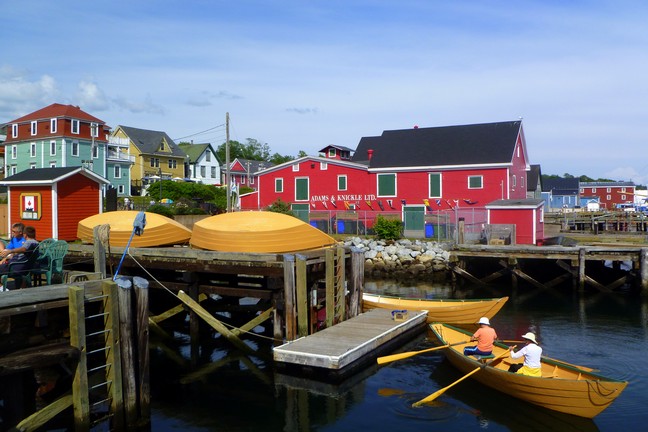


When they aren't patiently enduring the endless stream of tourists, the locals like to row out in their yellow dinghies.  I'm sure my astute readers will notice that the red building in the back ground is the exact same building found on the back of the 1975 Canadian $100 Bill.  It's a little hard to tell from this angle, but trust me, it's the same.


The Bluenose II was under repair, getting a face lift, but I found something even better.  This is the R/V Farley Mowat.  It was formerly the flag ship of Canadian hero Paul Watson's great Sea Shepherd fleet.  The anti-free speech Harper government of Canada stole the ship from Watson in 2008 though, after his crew was caught documenting the government killing baby seals.


Before we left I insisted on making one last stop - the beautiful Lunenburg Academy.  Perhaps the most remarkable heritage building in the entire province, the Lunenburg Academy has been designated a Municipal, Provincial, and National Historic Site.  Additionally, by visiting the Academy, yet another in a long list of blunders from my youth has been repaired.  I somehow failed to deem it important enough to visit this gorgeous building my first time to Nova Scotia.  I can now check the last item off my list of high school Nova Scotia "oopsies".  Success!


"Oh no! We're gonna die!"  Ha ha!  This is not quite the sight you want to see in front of you when you're travelling down the highway at high speed.  Thankfully it was just a semi-truck being towed backward by another semi-truck.  I have to admit, this was the first time I had ever seen that... weird.

Friday, February 25, 2011

EP Road Trip #3: Sugar Moon Farm

Recently I started volunteering at the YMCA Centre for Immigrant Programs. When I signed up I was told about a trip the Centre was taking to the Sugar Moon Farm in Englishtown. It's been a while since I've been on a Road Trip, so I was quite excited, and even more so when I heard it was a maple farm.


(The Sugar Moon Farm is located at one of the highest elevations in Nova Scotia, so the amount of snow it receives is exponentially greater than what I'm used to seeing in Halifax.)

While there are roughly 150 varieties of maple trees in the world, the Sugar Maple is the preferred species for making syrup because of its high sugar content. The Sugar Maple is native to the north-eastern United States and eastern Canada, which means this is the only region in the world that has the climate necessary for producing maple syrup.

Maple Sugaring is not a particularly new art form. In fact, First Nations people were slashing trees and collecting sap in birch bark buckets thousands of years before European settlers arrived. The European settlers though, were responsible for advancing the form to the more efficient drilling/tapping process used today.


(Our guide explains the early sap collecting process.)

Efficiency is a relative term I suppose, since sugar maple sap is 97% water. This means that you can easily drink it, but it also means that 40 Litres of sap must be evaporated to make 1 Litre of pure maple syrup. Furthermore, it means that one tree can only sustainably produce 1 Litre of syrup per year (sap only runs for a few weeks during the early spring).


(The brand new evaporator the farm installed this year.)

After the tour we received a free all-you-can-eat pancake lunch with pork sausages and veggie beans. I kindly helped the kitchen staff clean up by finishing off the leftovers to save on waste.


My favourite part of the tour was rolling maple sugar in the snow to make candy. The boiling hot, liquid maple sugar is ladled onto snow, and a popsicle stick is used to roll the quickly solidifying sugar into a lollipop-like treat.

I wanted to conclude this post by giving a big thank-you to the YMCA for allowing me to come along on the trip. It was a unique experience, and I look forward to many more.

Thursday, September 9, 2010

Quarterly Review #1, Part 3: August 2010

Continuing on with the EP Bike Trip trend, in mid-August I planned an 86 km round trip to Peggy's Cove to see what is perhaps the most famous lighthouse in Canada, if not the world. As regular readers will no doubt remember, things didn't quite go according to plan but that I eventually did make it. This was probably my favourite moment in August.

Speaking of cycling, I also met Jennifer Kean and Mike Cross in August. When I met Jennifer and Mike they were just finishing up their 22nd hour of non-stop continuous stationary cycling, in an attempt to raise money so that they could partake in a 12 day bicycle journey from Vancouver, British Columbia to Austin, Texas. The proposed journey was part of a larger effort by GiveToLive to raise money and awareness for cancer research.

While not as cool as cycling, the Harbour Hopper is definitely the most unique tour in Halifax. This amphibious vehicle is actually a refitted Vietnam War transport vessel, and takes customers on an hour long tour of Old Halifax and the Harbour. What makes the Harbour Hopper special is that it actually goes into the Harbour, and it even has VIP status to get within 50 metres of the Navy base. I would not have normally had the money to take this tour, but thankfully a friend from church bought a ticket for me as a treat. Let her contributions to the blog be duly noted.

My favourite festival of August was the Northern Lights Lantern Festival. It may not have been the largest festival, but it was definitely the most fun. This was not likely because of any one feature I suppose, so much as because of the people who were there. As I've mentioned before, the North End is my favourite community in Halifax because the people are just a bit more relaxed and friendly there than anywhere else in Halifax. I've always felt welcome whenever I've been there, even though I don't live there.

The most memorable moment in all of August for me though was my fantastic camping experience inKejimkujik National Park and National Historic Site. As the second instalment of the EP Road Trip series, this journey involved three days and two nights of camping, along with some great camp fire sing-along sessions and playing in the warm waters of Kejimkujik Lake. It was the first tick on an extensive list of Canadian National Parks, of which I intend to visit every single one.

Well, that concludes my look back at the last three months. Let me know in the comments section what your favourite post in that time was. Perhaps you have a suggestion for a new feature you'd like to see in the next quarter. Include that in your comment too, or send me an e-mail at davidrjmurray@gmail.com.

Now if you'll excuse me I must get back to more great adventures in history.

Monday, August 23, 2010

EP Road Trip #2: Kejimkujik National Park


One of my sub goals during all of my proposed travelling/living around this country is to visit every single National Park, Marine Conservation Area, and National Park Reserve in Canada. Over the past weekend I made yet another trip with my church's young adults group, this time to camp for two nights in Kejimkujik National Park. One Park down, 44 more to go.


The National Park system in Canada is a Federal initiative to protect and present outstanding representative examples of natural landscapes and natural phenomena that occur in the 39 natural regions of Canada. Kejimkujik National Park is the only inland National Park in Atlantic Canada, but it is rich in historical significance. The large lake in the centre of the Park served as an ancient "inland port" and safe haven, during the colder fall and winter months, to the Mikmaw (Mikmaq) people that lived here and would travel the complex network of rivers and lakes to arrive from their summer camps along the Atlantic coast.


Even today, visitors to the area still enjoy canoeing those same routes that Canada's original people paddled, as well as mountain biking, camping, and going on guided history walks to ancient historically significant areas. I was not able to see the famous Mikmaw stone carvings called Petroglyphs during this trip, due to time constraints, but I will return on a future trip to explore the park more thoroughly.


(Keji Beach at the peaceful, and surprisingly warm, Lake Kejimkujik.)


(The "Mighty" Mersey meandering its way through the old growth hemlock forests of Kejimkujik.)


(A family enjoys itself at the popular Mill Falls - once the location of a portable steam mill run by Morris Zwicker in the early 1900s.)


(A cable and cart system used to measure water depths at the centre of the river.)


(I set out on Saturday to find the Visitor Information Centre, which I thought was only 3 km away from my camp site. It turned out to be 7 km away. On the way back I took an even longer route through the trees to stay out of the blazing hot sun. It wasn't a complete disaster though, as I was able to get this beautiful shot - in my opinion the best hiking trail picture I've ever taken. Total hiking distance for the day ~ 20 km.)


(Some of my fellow church campers were nervous about the wildlife, but compared to Jasper National Park, in which you are almost guaranteed to see at least one ungulate and/or predator each time you visit, Kejimkujik National Park is about as wild as South Korea. This was the most vicious animal I could find.)

Sunday, August 8, 2010

EP Road Trip #1: Melmerby Beach

The EP Road Trip is a new feature I decided to add to Terra Nova, since I recently just completed my first one. An EP Road Trip follows the same guidelines as an EP Bike Trip - longer than 50 km away from Halifax, with a specific goal in mind - except it is taken in a motorized vehicle containing two or more people (you won't find any single passenger car journeys here).

This first ever EP Road Trip was the result of a decision by some of the members of my church's young adults group to go to a beach on the Northumberland Shore. The Northumberland Strait is famous for having the warmest sea water in Canada.

We piled five people into a tiny compact Chevrolet (probably an Aveo), and headed up the Veterans Memorial Highway - Highway 102 - to Truro, where we turned east on to the Trans-Canada Highway 104, and continued on to Melmerby Beach Provincial Park. It's just past New Glasgow, on highway 289 if you're following along on Google Maps.


Despite the beautiful weather, this normally popular beach was relatively empty when we arrived. It started to fill up later in the afternoon though, and by the time we left it finally started to look like a real beach.

I was initially sceptical about the warmest water claim, because of my less than pleasurable experience in the ice-cold waters of Crystal Crescent Beach. However, true to its billing, the waters of the Northumberland Strait are exceptionally pleasant. Depending on which mini-current happened to be flowing past my legs at any given moment, the temperature of the water could even feel warmer than that of the air (especially with the breeze). I've had less pleasurable swims in indoor swimming pools, which are usually kept relatively cold for the competition swimmers.

While the water may be warm, it is also salty. Up until this day, my childhood beach swimming experience had been one of swimming in the fresh water lakes of Alberta exclusively. The salt-water of the ocean though is so disgusting, that when some of it splashed up into my mouth off of a wave, the taste nearly gave me an upset stomach. Don't worry though, I ate two large chocolate chip cookies, a samosa, two bananas, a peach, a bagel, a chicken sub, three peach muffins, and two large pieces of pizza to settle it down.


(I touched up this photo to look like something you might find in an old book of photographs of Nova Scotia.)


(Sand castle enjoying the sun.)


(Speaking of sand castles, how about this sand mountain I made with its own road that leads in to itself, via a moat that kind of looks like a road? It was my first attempt to make an M.C. Echer-esque structure. I think I may need some more practice.)


(Good view of a great beach. Is that Superman in the air over there...?)


(Oh, no, never mind, it's just a killer whale. My mistake.)


(It's always better to be safe than sorry, I agree, but I'm not too certain Melmerby Beach with its half-metre tall "waves" is going to see any surfers who need to be rescued any time soon. I suppose the life guard might use one of them as a floatation device on which to paddle out to a would be victim.)