Showing posts with label National Historic Site. Show all posts

Monday, August 13, 2012

EP Road Trip: Mahone Bay and Lunenburg

EP Dave is back! And what a way to rejoin the world - with a road trip! My roommate was leaving back home for Korea, and I thought I would like to treat her to a special trip.

When I was in Korea in 2009, I was guided on a train tour of South Korea by a total stranger. Some random woman I met in the Secret Garden at Changdeok Palace in Seoul, South Korea, befriended me and then invited me on a tour of all her favourite spots around South Korea. It was truly an experience I would never forget, and one that would change my life forever.

I asked the woman how I could ever repay her, since I wasn't exactly loaded with money at the time. She said that I could repay her by returning the favour to any Korean visitors I met in Canada.

So, fast forward to January 2012, and my roommate of the past seven months is about to return home to Korea without visiting the one place every Korean knows, PEI (the home of "red-hair Anne"), and only ever having travelled by bus to tiny Truro. No offense to Truro, as I'm sure it's a lovely town, but the Acadien who lived there before the British stole it from them originally named the place "Village in the burnt wood."  That's probably not exactly the postcard image of Canada she would like to take home with her.

I knew what I had to do. While I couldn't afford the time or the trip to PEI, I did the next best thing - I took take her to Lunenburg.

According to Wikipedia, Lunenburg was one of the first attempts by the British to settle British Protestants in Nova Scotia, back in the 1750s. This makes it somewhat special for two reasons.  First, they actually settled a new area and didn't just steal a settlement from the French or Mi'kmaq, but also this influx of Protestants resulted in Lunenburg being attacked by the Catholics nine times!

More importantly, in modern times, Lunenburg is the best remaining example of a planned British colonial settlement in North America.  It was awarded UNESCO World Heritage Site status, accordingly, in 1995.


On the way over, we took the Lighthouse Route along the coast and stopped in at beautiful Mahone Bay.  Mahone Bay is famous for its cafe on the side of the road.  No wait... that's not right.


Aha! That's more like it. Mahone Bay is famous for its pretty downtown Main Street, and its three churches more than 250 years old (two-and-a-half of which you can see in this picture).  On a side note: I've been waiting more than two years to take this picture!  Success!


Of personal significance to me was a trip to the excellent independent tea store, The Tea Brewery.  The store's motto is "where there's tea, there's hope."  What more do I need to say?  You can clearly see why someone would have biked 100km just to buy some superb Blueberry Tea.  I only wish I had thought of it first.


I mentioned earlier the pretty downtown for which Mahone Bay is well known.  That beautiful yellow house in the background is a store.  The entire Main Street is filled with others just like it.  It's well worth an hour of your time to stroll up and down this street if you're ever in Mahone Bay.  You won't soon forget it.  Nova Scotia has some of the most delicious ice cream I've ever tasted, as well.


Finally we got to Lunenburg and stopped for a picnic.  Mihwa is an excellent cook and made the most incredible "bulgolgi wraps."  Even more perfect though was the view.  I enjoy Halifax, but this is really what I had pictured when I planned on moving to Nova Scotia.


Lunenburg is famous for its well-maintained, 18th Century downtown storefronts, painted every colour of the rainbow (and some extras).  I had visited here as a youth, back in my high school days, but I did not understand the significance of the town at that time, and shamefully I must admit I did not appreciate it as much as I should have.  I'm grateful for the second chance to walk these streets.


If you don't feel like walking, that's okay too.  Even the tour guides get into the spirit and the costume of the 18th Century.  I was a little disappointed that the horse didn't whinny with an accent though.


The real excitement was down on the waterfront.  Not only were the Tall Ships in town, but this year marks the 200th anniversary of the War of 1812, during which the British burnt down the White House (hoo-ah!)  There were parties and festivities everywhere.
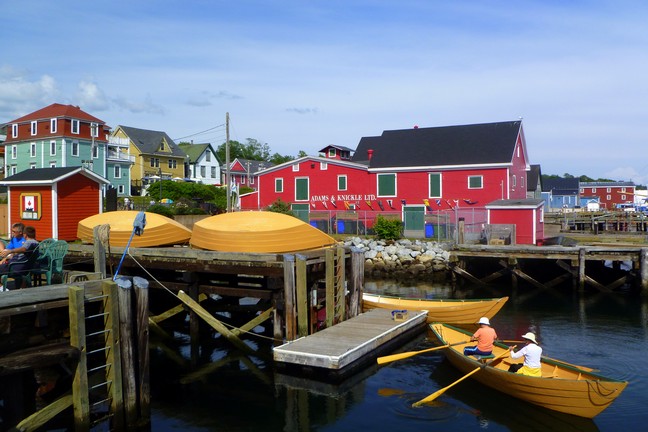


When they aren't patiently enduring the endless stream of tourists, the locals like to row out in their yellow dinghies.  I'm sure my astute readers will notice that the red building in the back ground is the exact same building found on the back of the 1975 Canadian $100 Bill.  It's a little hard to tell from this angle, but trust me, it's the same.


The Bluenose II was under repair, getting a face lift, but I found something even better.  This is the R/V Farley Mowat.  It was formerly the flag ship of Canadian hero Paul Watson's great Sea Shepherd fleet.  The anti-free speech Harper government of Canada stole the ship from Watson in 2008 though, after his crew was caught documenting the government killing baby seals.


Before we left I insisted on making one last stop - the beautiful Lunenburg Academy.  Perhaps the most remarkable heritage building in the entire province, the Lunenburg Academy has been designated a Municipal, Provincial, and National Historic Site.  Additionally, by visiting the Academy, yet another in a long list of blunders from my youth has been repaired.  I somehow failed to deem it important enough to visit this gorgeous building my first time to Nova Scotia.  I can now check the last item off my list of high school Nova Scotia "oopsies".  Success!


"Oh no! We're gonna die!"  Ha ha!  This is not quite the sight you want to see in front of you when you're travelling down the highway at high speed.  Thankfully it was just a semi-truck being towed backward by another semi-truck.  I have to admit, this was the first time I had ever seen that... weird.

Monday, September 5, 2011

Nova Scotia National Historic Site #14: Akins House


This small cottage on Brunswick Street, in North End Halifax, was the home of Thomas Beamish Akins. Built in the 1790s, T.B. Akins' house is the oldest dwelling in Halifax.

Thomas Beamish Akins was born on February 1, 1809, in Liverpool, Nova Scotia. His mother died when he was 10 days old, after which time he moved to Halifax and was there raised by his mother's family. Akins went on to become a relatively successful lawyer with his cousin, Beamish Murdoch, but neither married or exhibited any interest in public or political matters. He never once ventured outside Nova Scotia.

Akins did, however express a keen interest in history. He entered a contest and won a silver medal from the Halifax Mechanics' Institute for his 1838 "Essay on the Early History of Halifax." Although, his essays were apparently rather boring, they did rely heavily on "primary sources" which still makes them useful to this day. In 1882 Akins was made president of the Nova Scotia Historical Society

In 1811, Sir George Prevost complained to the Provincial Assembly of Nova Scotia that its public records were "in a ruinous state." However, it would take numerous government bunglings before something was finally done about it (are you surprised?) Opposition member, Joseph Howe, distressed by the rapidly decaying condition of the records, moved in 1851 that the province do something to examine, preserve and arrange the documents. Enter Thomas Akins, who agreed to become the first ever provincial Commissioner of Public Records in Canada, for any province, on May 29, 1857.

This was an important moment in Canadian history, since the creation of the Nova Scotia provincial archives predated that of the Dominion's archives by fifteen years. Furthermore, there would not be a second provincial archive created until Ontario established its own in 1903. Thanks to some rare political forward thinking, Nova Scotia now enjoys one of the most complete sets of public records in the country.

Akins maintained his position faithfully for 34 years until his death in 1891. Upon passing away, Akins bequeathed his entire, substantial personal collection to the provincial archives.

For more information on Thomas Beamish Akins, please refer to his biography, here.

Tuesday, May 31, 2011

HRM Bike Week 2011, Part 1: Take A Seat

From May 27, to June 5, the best event of the year will be taking place at various locations around the city. HRM Bike week was developed to celebrate cycling and encourage and nurture a cycling friendly environment in the Halifax area, as well as to encourage new riders to give it a try and riders who haven't tried it in a while to dust off their old two wheelers and experience the joy of peddling once again.

I specifically remember seeing advertisements for this ten day event in the Farmers' Market on my first day out exploring when I arrived here last May. However, I was disappointed to see that the week in question would be the week I would be on my train journey to Vancouver. Consequently, I've been waiting with anticipation for this year's event for a full 12 months, and I don't plan to miss any more of it than I have to.

The first event I attended took place on Monday, May 30, on the Dalhousie University campus. The Halifax Cycling Coalition organized a showing of a film entitled Take A Seat, and for $8 I received admission, free cake, free popcorn, free apple juice (or Daveoline, as it's been called in the past), and a 3 year membership to the Halifax Cycling Coalition.

Take A Seat is the story of an amazing young man from England, Dominic Gill, who rode a tandem bicycle from Prudhoe Bay, Alaska, 29 519 km down the western coast of the Americas until he reached the most southerly city in South America, Ushuaia. The bicycle weighed far too much for him to peddle the whole journey on his own, and so along the way he met, and was able to convince over 270 people to jump on the back of his bicycle and travel anywhere from a few minutes, to a few days with him to help him out. The whole journey took him over two years.

To get an idea of how long this is, find Prudhoe Bay, Alaska, on Google Maps. Zoom in until the scale reading reads about 10km (bottom left corner of the map), and then commence clicking and dragging the screen all the way down to Ushuaia, Chile. The whole operation took me about eight minutes of constant dragging. I got lost a couple of times around Mexico, and ended up in the Pacific Ocean before I widened the image to see where I was.

How long did it take you? How many times did you get lost? How many clicks did it take? Now, imagine each one of those drags being about 2-5 days worth of peddling on a 100 kg bicycle.

Watching the film I remember strongly the sense of isolation he related feeling as he spent a lot of the journey by himself. To Dominic, being alone was the hardest part. Additionally, I was struck by his determination to push through, even after suffering hundreds of tube punctures, and breaking his bicycle numerous times in different places, not to mention having intense diarrhoea at one point.

Mostly though, I smiled at the people he met along the journey who recognized someone doing something special, and who wanted to be involved in it themselves. Watching Take A Seat has renewed my love of cycling, my love of people, and my love for the sense of adventure that prompted me to embark on this grand mission of living in every province, and visiting every National Historic Site of Canada.

Thursday, December 23, 2010

Random Halifax Picture #13


When I first saw these stocks set up between the buildings of the Privateers Wharf Historic Properties, I just thought it made for a funny picture. For the last few months though, I had worked at a Subway restaurant, and it just dawned on me that a Subway restaurant would be the perfect place for one of these.

I can see it now: Anyone who asks for "extra extra onions" or "loads of pickles," or lets his/her son squish his nose and mouth up against the sneeze guard I had just cleaned, gets locked up in the stocks. Anyone who was made late by the person who ordered five subs during the supper rush gets two free throws of a rotting tomato or onion from the compost bin. The over all customer satisfaction rate from all those non-offenders who now get to have some pickles on their subs too would soar through the roof! Think about it Subway, and give me a call.

Sunday, December 12, 2010

Nova Scotia National Historic Site #13: Duc D'Anville Encampment


On September 18, 1710, 42 British vessels carrying 2000 troops set sail from Boston in an attempt to capture Port Royal - the French stronghold in what was then known as Acadia. Though the Acadians fought valiantly, they were eventually forced to surrender to the overwhelming British attack (the British honoured the formidable French defenders by allowing them to march out with colours flying, drums beating, and with all their bags and arms in hand).

The capture of Port Royal signalled the beginning of the end of French rule in Acadia - which was officially ceded to the British at the signing of the Treaty of Utrecht in 1713. However, the French would not stop fighting to regain control of their former capital for the next 50 years, and that leads us to Duc D'Anville's Expedition.

After losing another battle in what would later come to be known as Cape Breton Island, Louis XV ordered Jean-Baptiste Louis Frederic de La Rochefoucauld de Roye, Duc D'Anville, to lead a massive fleet of 64 ships and 11 000 troops to Port Royal (by this time renamed Annapolis Royal by the British in honour of Queen Anne) in one great effort to regain control of New France.

Long story short, the Expedition was a complete disaster, with numerous ships being battered by severe storms - one ship was even struck by lightning - and large numbers of troops succumbing to typhus and scurvy. After nearly 3 months at sea, the shattered Expedition (now only two-thirds its original size - limped into what is now known as Halifax Harbour in 1746, where it encamped at Chebucto, just north of what would later become Halifax. It was here, six days later, that Duc D'Anville and a great number of his men would die from disease.


Now though, Chebucto is just a small plot of grass and trees (see picture at top of article) next to a restaurant on the Bedford Highway, with only this cairn and plaque to indicate that anything significant happened here.

Monday, October 25, 2010

Nova Scotia National Historic Site #12: Old Burying Ground

I've mentioned the Old Burying Ground in a couple of blog posts already, so I figured it was about time I made an actual post on it.


Located right on the corner of Spring Garden Road and Barrington Street, in Old Town Halifax, the Old Burying Ground was the original cemetery built in 1749 at the founding of Halifax. While there are only 1200 headstones in the cemetery today, over the years some 12 000 people have been interned here. Of course, the Old Burying Ground is also the home of the impressive Welsford-Parker Monument.


An interesting fact is that all of the headstones were carved by hand using chisels and wooden mallets. Many of the original slate stones were quarried and carved around Massachusetts Bay and shipped over to Halifax before the American Revolution. The newer headstones are carved from local ironstone though, and are apparently of much lower quality because of it.

Tuesday, September 21, 2010

Nova Scotia National Historic Site #11: Fernwood


Fernwood Manor (above) is one of two houses, owned by brothers, that were the first houses along the Northwest Arm. Fernwood Manor and its sibling house are part of a Gothic revival neighbourhood near Point Pleasant Park in a southern suburb of peninsular Halifax. It's also a private, gated neighbourhood - which makes it really hard to photograph - nor is it well promoted either. I couldn't find any information about it on the Internweb, and even a local who questioned me on why I was taking pictures of private homes on private property didn't know that they were part of a neighbourhood that was a National Historic Site. Of course, after I mentioned I was a photographer for Ea-pea Dave's Terra Nova he was helpful and informed me about the brothers and bit about the Northwest Arm. But still....

(Note: if the picture seems a bit odd, it's because I was shooting directly into the sun, and tried to mend it afterwards on my computer with my limited retouching skills. Trust me, it's a lot better than it was.)

Thursday, September 9, 2010

Quarterly Review #1, Part 3: August 2010

Continuing on with the EP Bike Trip trend, in mid-August I planned an 86 km round trip to Peggy's Cove to see what is perhaps the most famous lighthouse in Canada, if not the world. As regular readers will no doubt remember, things didn't quite go according to plan but that I eventually did make it. This was probably my favourite moment in August.

Speaking of cycling, I also met Jennifer Kean and Mike Cross in August. When I met Jennifer and Mike they were just finishing up their 22nd hour of non-stop continuous stationary cycling, in an attempt to raise money so that they could partake in a 12 day bicycle journey from Vancouver, British Columbia to Austin, Texas. The proposed journey was part of a larger effort by GiveToLive to raise money and awareness for cancer research.

While not as cool as cycling, the Harbour Hopper is definitely the most unique tour in Halifax. This amphibious vehicle is actually a refitted Vietnam War transport vessel, and takes customers on an hour long tour of Old Halifax and the Harbour. What makes the Harbour Hopper special is that it actually goes into the Harbour, and it even has VIP status to get within 50 metres of the Navy base. I would not have normally had the money to take this tour, but thankfully a friend from church bought a ticket for me as a treat. Let her contributions to the blog be duly noted.

My favourite festival of August was the Northern Lights Lantern Festival. It may not have been the largest festival, but it was definitely the most fun. This was not likely because of any one feature I suppose, so much as because of the people who were there. As I've mentioned before, the North End is my favourite community in Halifax because the people are just a bit more relaxed and friendly there than anywhere else in Halifax. I've always felt welcome whenever I've been there, even though I don't live there.

The most memorable moment in all of August for me though was my fantastic camping experience inKejimkujik National Park and National Historic Site. As the second instalment of the EP Road Trip series, this journey involved three days and two nights of camping, along with some great camp fire sing-along sessions and playing in the warm waters of Kejimkujik Lake. It was the first tick on an extensive list of Canadian National Parks, of which I intend to visit every single one.

Well, that concludes my look back at the last three months. Let me know in the comments section what your favourite post in that time was. Perhaps you have a suggestion for a new feature you'd like to see in the next quarter. Include that in your comment too, or send me an e-mail at davidrjmurray@gmail.com.

Now if you'll excuse me I must get back to more great adventures in history.

Friday, September 3, 2010

Nova Scotia National Historic Site #10: Henry House


For twenty years this ironstone and granite residence on Barrington Street was the home of William A. Henry, a Father of Confederation, and a former Attorney General of Nova Scotia and Mayor of Halifax, and an original Judge on the Supreme Court of Canada from its inception in 1875 until his death in 1888. The masonry of the gable wall and the surrounds of the windows are Scottish in character, and are representative of the style of many Halifax residences of the early 19th century.

Now Henry House is an excellent pub, with the Best Fishcakes and Best Pub Food according to the readers of The Coast in a 2009 poll. Interestingly, it is also the very first place I ever ate when I came to Halifax back in May, during my cross-Canada adventures. I had some kind of three meat meat-loaf dish, the name of which I unfortunately cannot remember, and it was excellent. It is located across from the HI Hostel, and only a block away from the VIA Rail train station for your travelling convenience.

Thursday, August 26, 2010

Nova Scotia National Historic Site #9: York Redoubt


York Redoubt was first fortified in 1793, when war broke out between Britain and France. General James Ogilvie, the British commander at Halifax during this time, built a two-gun battery along the south shore of the Northwest Arm, near the entrance, to help defend the harbour.

The defences were later improved by Prince Edward, the fourth son of King George III, when he was commander at Halifax from 1794 to 1800. By 1800 the site had an eight-gun battery and a round Martello Tower, with a signal mast to provide early warning of an enemy attack. Edward named the site York Redoubt in honour of the Duke of York, his brother.

Friday, August 6, 2010

Nova Scotia National Historic Site #8: HMCS Sackville


Corvettes were small, fast ships used by the Canadian Navy in World War II to protect convoys, because they were the only ships fast enough to be able to defend against and potentially destroy the infamous German U-boats.

The HMCS Sackville, pictured above, was commissioned on December 29, 1941, and was built at St. John, New Brunswick. It was credited with a "possible kill" and a "possible damage" against German U-boats in WWII. More importantly though, it is the last remaining Corvette ship of thatera.

The HMCS Sackville is now a National Historic Site, and is maintained as a living monument at Sackville Landing on the Halifax Waterfront, by the Canadian Naval Memorial Trust. It is free to walk on and explore the ship during the summer months when it is open for viewing.


(HMCS Sackville, in its original paint scheme, as viewed from the HMCS Athabaskan battle ship, during the International Fleet Review Week. The blue and white colours made the ship appear to blend in with the waves on the ocean, and made it more difficult for enemy submarines or planes to judge the distance to the ship due to the relatively poor tracking technology of the time.)

Saturday, July 24, 2010

Nova Scotia National Historic Site #7: Halifax Court House


The Halifax Court House on Spring Garden Road was completed in 1863, and since then has housed both county and provincial courts. A rear addition was built in 1881, and the west and east wings in 1908 and 1930 respectively. It was designed and built by the famed Toronto architectural firm, William Thomas and Sons.

Friday, July 23, 2010

Nova Scotia National Historic Site #6: Halifax Armouries


The Halifax Armoury was constructed by the federal government between 1895 and 1899 as part of an expansion and reform of the Active Militia. Innovative for its time, this fully equipped training centre was substantially larger than earlier drill halls, and included an indoor shooting gallery and lecture rooms (novelties at the turn of the century). This bold, medieval fortress-like design by Chief Architect Thomas Fuller, would go on to influence Canadian drill hall design for several decades. It is still in use as a training facility for the military today.


Tuesday, July 20, 2010

Nova Scotia National Historic Site #5: CSS Acadia


CSS Acadia is a former hydrographic surveying and oceanographic research ship once used by Canada to map its coastal waters. Launched in 1913 and named after the original name for Nova Scotia under French colonial rule, Acadia provided landmark surveys of Sable Island, the Bay of Fundy, and provided information instrumental in the establishment of the port of Churchill, Manitoba.

Later, the prefix CSS was changed to HMCS when Acadia spent two years from 1917 to 1919 on anti-submarine patrol in the Bay of Fundy and Gulf of St. Lawrence. During WWII, HMCS Acadia patrolled the waters at the entrance to Halifax Harbour, and also saw extensive action as a training ship. After the war, Acadia resumed work as a survey vessel for the third time, and in 1962 rescued hundreds of people from forest fires in Newfoundland. By the end of its career, CSS Acadia had charted nearly every metre of water in Atlantic Canada as well as a great percentage of the Eastern Arctic Coast.

Currently CSS Acadia belongs to the Maritime Museum of the Atlantic in Halifax where it is moored, and is open to the public every year from May to October. CSS Acadia is the only known ship still afloat to have survived the Halifax Explosion, and is also the only ship still afloat to have served the Royal Canadian Navy in both World Wars.

Saturday, July 17, 2010

Nova Scotia National Historic Site #4: The Citadel


Citadel Hill is an 80 metre tall glacial drumlin with a commanding view of Halifax Harbour. Citadel Hill's strategic value was the primary reason the British chose to maintain a military base on the east side of Nova Scotia. The current star-shape fortress currently atop Citadel Hill, formerly known as Fort George, is actually the fourth fortress design to occupy the hill, and took 28 years to build.


It took so long to build, because the entire fortress had to be set into the hill so that only the parapet was in view from the base of the hill. Should an enemy soldier miraculously escape having his head blown off at the bottom of the hill, from well inside the range of the British rifles, he would be met with the precursor to land mines just outside the base of the wall. Should he pass that, he would fall off the edge of the wall into the hidden ditch, roughly 10 metres in depth, where if his legs or neck were not broken, he would be pelted with "balls of spikes attached with chains meant for taking down ship masts" from the cannons. Or he may be lucky and merely hit in the back of the head by the sharp shooters hiding inside the secret tunnels behind him and aiming through the slits in the wall.


The wall was designed to be, and in fact was, the most technologically advanced fortress of its time. Its construction was ordered because of fear of an impending American attack. Ironically, the largest threat the Americans ever posed to the British at Halifax was during the War of 1812, when US President James Madison declared his intentions to claim what would later become Canada, for America. The War of 1812 ended in 1814, before construction of Fort George had even begun.


Today, Fort George (The Citadel) is a National Historic Site managed by Parks Canada. Costumed actors bring life at the fort in 1869 alive for the numerous visitors, and many rooms are open for guests to tour at their leisure. Even the secret tunnel in the outer wall is open.


There are numerous demonstrations that take place during the day, and the highlight of any visit is the firing of the "noon gun". Overall the fortress is in remarkably good condition, and it is my strong opinion that any trip to Halifax should definitely include a visit to this fabulous living museum.


(Rifle firing demo.)


(Getting ready to fire the noon gun.)


(Ceremonial cutting of the cake for Parks Canada's 125th birthday on July 17, 2010. I had four pieces.)


(The Pipes and Drums of the 78th Highlanders. The pipers have green coats because they were not paid by the military like the drummers or brass band members, but rather by the officers personally. Having a personal pipes regiment was a sign of prestige for British officers, and so an officer would dress his pipers with extra brass and more regal colours to show off how rich he was.)


(Changing of the guard.)


(The new recruits practice loading a cannon.)


(Military drill demonstration. Look at how tightly they walk together.)


(A special treat: this is the actual cloak that the legendary General James Wolfe was wearing when he was shot and killed on the Plains of Abraham, in 1758. Wolfe's Adjutant General and friend, Isaac Barre, saved the cloak for posterity. It currently belongs to Her Majesty Queen Elizabeth II, and is on loan to the Army Museum at The Citadel.)


(Closing up the gates.)